

Every roof that needs occasional access, for maintenance, HVAC servicing, solar panel checks or a short refurbishment, creates the same problem: how do you protect people working near the edge without drilling into a membrane you don't want to compromise, or building something that has to stay there forever?
That's exactly what non-penetrating and temporary roof guardrails are designed to solve. They can be removed, reconfigured or relocated once the work is done.
This guide walks through:
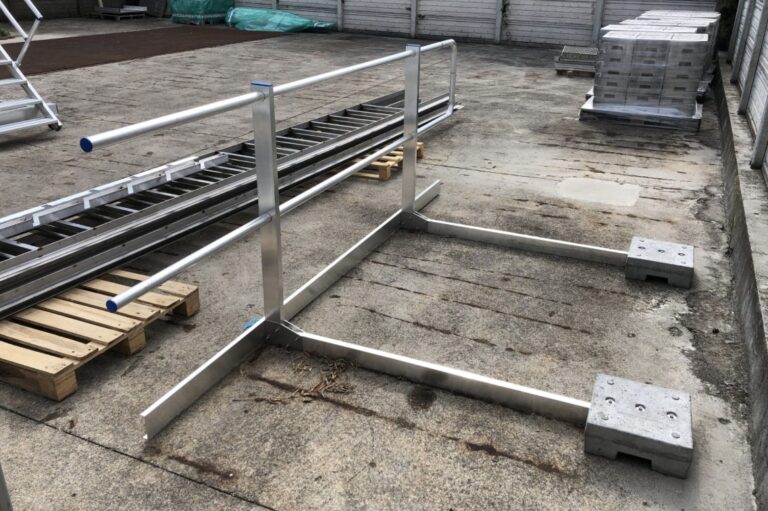
A non-penetrating roof guardrail system (often called a temporary roof guardrail, freestanding guardrail or non-penetrating safety railing) is a fall-protection barrier that stays in place through its own weight and geometry rather than through fixings driven into the roof deck. The base sections carry counterweights that keep the guardrail stable against wind and impact loads, while the upright posts and horizontal rails form the same collective barrier a bolted system would provide.
Because nothing penetrates the membrane, this type of roof edge protection is the standard choice on flat and low-slope roofs where the waterproofing is under warranty, where the building is leased rather than owned, or where the guardrail run is only needed for the length of a specific project: a re-roofing job, a solar installation, or seasonal maintenance.
Both fixed and non-penetrating guardrails are collective protection systems, and both can meet the same structural test classes. The real differences show up in installation method, reversibility and the type of project each one suits.
| Criteria | Non-penetrating / temporary guardrail | Fixed / permanent guardrail |
|---|---|---|
| Fixing method | Counterweighted base or clamp, no drilling | Bolted or welded into the roof structure |
| Roof membrane impact | None. Waterproofing stays intact | Requires sealed penetrations at each fixing point |
| Typical duration | Project length: re-roofing, maintenance, seasonal access | Permanent, for roofs with frequent ongoing access |
| Reconfiguration | Can be moved, extended or removed without a trace | Fixed layout; changes require new structural work |
| Load path | Distributed through the counterweight and base footprint | Transferred directly into the roof structure |
| Best suited to | Leased buildings, membrane roofs under warranty, short-term works | Owner-occupied sites with long-term rooftop access |
Neither option is inherently better. The right choice depends on how long the access is needed and what the roof structure and warranty terms allow.
Not sure which category your project falls into? Creda's technical office can review your roof drawings and tell you within a short call.
Non-penetrating edge protection covers a family of systems built around the same no-penetration principle:
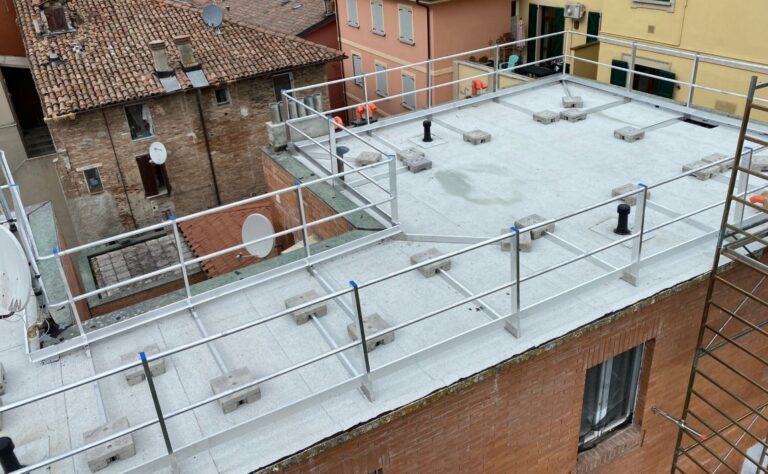
Set against a bolted alternative, a non-penetrating system offers a specific set of practical advantages:
Temporary and non-penetrating systems are expected to meet the same structural and safety standards as permanent ones.
Because a non-penetrating guardrail's stability depends entirely on its counterweight and base footprint rather than a fixing into the structure, the load calculation has to account for the actual wind exposure, roof height and layout of the specific site.
Six factors decide which non-penetrating configuration is right for a given roof.
| Factor | What to check |
|---|---|
| Roof slope | Most non-penetrating systems are rated for flat or low-slope roofs up to around 10 degrees; steeper roofs usually need a different anchoring approach. |
| Duration of use | A one-off project favours a simple freestanding system; recurring access favours a system designed for repeated assembly and strike. |
| Membrane and warranty | Confirm whether the roofing warranty restricts penetrations before specifying anything bolted. |
| Wind exposure and height | Taller buildings and exposed sites need a heavier or wider counterweight footprint, calculated for the specific location. |
| Reconfiguration needs | Phased works need a modular system that can be extended, shortened or moved section by section. |
| Storage and handling | Fold-flat or lightweight aluminium options reduce lifting and storage requirements between uses. |
These factors don't work in isolation. A roof with a strict no-penetration warranty and a difficult wind exposure, for example, needs a base footprint and counterweight calculated for that specific combination.
Creda was founded in 2019 and has grown to a team of 19 people with one focus: aluminium access and safety systems designed and built entirely in-house, in Italy. That includes temporary and non-penetrating roof guardrail systems, and it's where Creda's approach differs from most suppliers in this space.
Almost every non-penetrating guardrail on the market is a standard, catalogue product: a fixed range of base sizes and counterweight options that a project has to be fitted into. Creda works the other way around. We are among the very few manufacturers in Italy that build every guardrail, whether temporary or permanent, non-penetrating or bolted, completely to measure, engineered around the actual roof geometry, wind exposure and load case of your site rather than adapted from a standard catalogue.
If your project needs a non-penetrating system for a short re-roofing job, or a temporary guardrail that has to work around an unusual roof layout, Creda's technical office can start from your site rather than from a catalogue.
Talk to our technical office about your temporary or non-penetrating roof guardrail project.
Creda Enterprise S.r.l.
OPERATING OFFICE:
Via Pacinotti, 42 - 20094 Corsico (MI)
Milano - Italia
Tel. +39 02/47753091
LEGAL OFFICE:
Via Monte Rosa, 21 - 20149 Milano (MI)
Offices:
Monday - Friday
8.30 am - 12.30 pm / 1.30 pm - 5.30 pm
Warehouse:
Monday - Friday
8.30 am - 12.30 pm / 1.30 pm - 5.30 pm
Closed:
Saturday and Sunday
© 2021 Copyright - CREDA Enterprise S.r.l. - VAT 10549250966