

Falls from fixed ladders are one of the most common causes of injury during maintenance, inspection and access work at height. Anyone specifying a permanent ladder for a silo, tank, roof or industrial platform eventually runs into the same question: does this ladder need a cage, and which ladder cage requirements actually apply to it? The answer depends on the total climbing height, on where the installation sits, and on which standard the project has to satisfy.
In this guide you will find out:
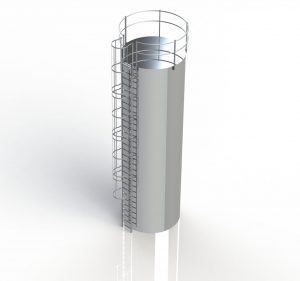
A fixed access ladder with a full-height safety cage on an industrial storage silo.
A ladder cage, also called a safety hoop, guard hoop or crinoline depending on the market and the supplier, is a series of curved rings fixed permanently around a fixed ladder's climbing space.
Unlike a harness or a lanyard, it is a passive, collective form of fall protection: it doesn't need to be worn, checked out, or clipped in, and it protects anyone who climbs the ladder without relying on individual behaviour. It reduces the chance of a backward fall by giving the body something to catch against. However, it does not replace a proper risk assessment, training, or a rescue plan for working at height.
Almost every regulation ties the requirement to the ladder's total climbing height rather than to the type of structure it serves. The general principle is simple: below a certain height, an unprotected climb is considered an acceptable risk when the ladder is well designed and used correctly; above it, a collective protection measure becomes mandatory, whether that's a cage, a rest platform or an engineered fall-arrest system.
Where regulations disagree is on where exactly that line sits, and on what happens once you cross it:
A few situational factors tend to push the requirement lower even where the letter of the regulation would otherwise allow an unprotected climb: ladders in public or uncontrolled areas, exterior ladders exposed to wind and precipitation, ladders serving infrequent but higher-risk access (roofs, silos, tank tops), and any case where no alternative engineered fall-arrest system is planned.
EN ISO 14122-4, "Safety of machinery: Permanent means of access to machinery, Part 4: Fixed ladders" is the harmonised European standard most manufacturers, including Creda, design and certify their cage ladders against.
It sets out, among other things:
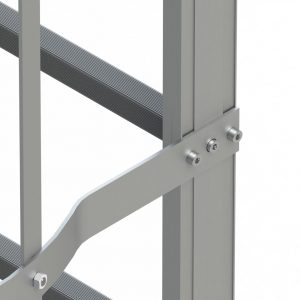
Close-up of an aluminium cage ring bolted to the ladder's vertical stringer, independently of the rungs.
EN ISO 14122-4 is a harmonised standard rather than a law in itself, so it takes effect through each member state's own workplace safety legislation, with the supporting dimensions set out at national level. Italy's D.Lgs 81/2008 is a useful illustration: it sets out the same underlying geometry as EN ISO 14122-4, a rigid, permanently fixed circundant protection above a set height, while specifying its own minimum cage diameter of 600 mm, against the 650 mm the ISO standard recommends.
A ladder built to satisfy both, as Creda's cage ladders are, simply follows whichever figure is the more demanding of the two for the project in question.
The regulatory framework in the United States offers a clear contrast to European guidelines, making it an essential consideration for organizations operating across both jurisdictions. Under OSHA standard 1910.28, fixed ladders installed or replaced after November 19, 2018, that extend 24 feet (approximately 7.3 meters) or higher must feature either a Personal Fall Arrest System (PFAS) or a Ladder Safety System (LSS).
As a result of this rule, standalone cages no longer satisfy federal compliance standards for new fixed ladder installations.
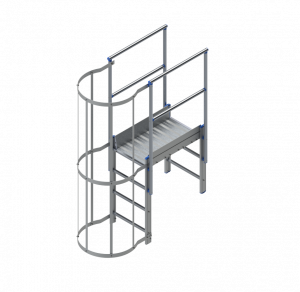
A ladder cage extended above the rooftop landing, with a guardrail continuing the protection at the exit point.
| Standard / Regulation | Applies in | Cage required from | Legal status |
| EN ISO 14122-4 | European Union (harmonised standard) | ~3 m (2.2-3 m for first hoop) | Harmonised technical standard, referenced by national law across the EU |
| D.Lgs 81/2008 | Italy | Circundant protection above set heights; 600 mm ring diameter | Binding national law |
| OSHA 1910.28 / 1926.1053 | United States | New installs: no cage allowed, LSS/PFAS required above 24 ft | Binding federal regulation |
The examples below cover the details that most often separate a compliant ladder cage from one that only looks the part.
| Scenario | Compliant example | Non-compliant example |
| Start height of the cage (EU) | First hoop installed between 2.2–3 m above the base, matching the EN ISO 14122-4 criterion for a new installation. | Cage started too high up the ladder, or omitted altogether below the required height, leaving the lower climbing section unprotected. |
| New installation in the US | A newly installed fixed ladder over 24 ft is fitted with a Ladder Safety System or Personal Fall Arrest System, per OSHA 1910.28. | A fixed ladder installed after 19 November 2018 relies on a cage alone, with no LSS/PFAS in place, which is non-compliant regardless of the cage's build quality. |
| Extension above the landing | The cage or guardrail continues above the last rung, per EN ISO 14122-4 (EU) or at least 36 in (US), so the operator has something to hold onto before stepping off. | The cage stops flush with the top rung, leaving the operator unsupported exactly at the most dangerous transition point. |
| Condition and fixing | Rings are rigid, smooth-surfaced and bolted independently of the rungs, as on Creda's aluminium cage ladders, and inspected on a set schedule. | Corroded or loose hoops, or a cage welded directly to worn rungs, that no longer offers a dependable rigid barrier. |
Creda designs and manufactures its cage ladders entirely in-house, in aluminium, using its modular "Over the Top" system, with no welding on site and every dimension built to the project's actual access point rather than adapted from a catalogue size.
The cage's inner diameter is available in both the 600 mm (D.Lgs 81/2008) and 650 mm (ISO 14122-4) configurations described above, the rings are bolted independently of the rungs for a rigid, inspectable structure, and the full system is backed by a technical office that follows the project from design through to installation.
Get in touch with our technical team to check which standard and which cage configuration your project needs.
Creda Enterprise S.r.l.
OPERATING OFFICE:
Via Pacinotti, 42 - 20094 Corsico (MI)
Milano - Italia
Tel. +39 02/47753091
LEGAL OFFICE:
Via Monte Rosa, 21 - 20149 Milano (MI)
Offices:
Monday - Friday
8.30 am - 12.30 pm / 1.30 pm - 5.30 pm
Warehouse:
Monday - Friday
8.30 am - 12.30 pm / 1.30 pm - 5.30 pm
Closed:
Saturday and Sunday
© 2021 Copyright - CREDA Enterprise S.r.l. - VAT 10549250966